Turning 40 does not mean it is time to start training less. For many women, it means it is time to start training with more purpose.
The workouts that worked in your 20s and 30s may not always feel the same in your 40s. Recovery can change. Body composition may begin to shift. Muscle can become harder to maintain. And for women entering perimenopause, changing hormone levels can add another layer to the equation.
None of that means your best years of fitness are behind you.
In fact, your 40s can be the perfect time to become stronger, build more muscle, improve your body composition and create the kind of training habits that can continue paying off for decades.
The key is understanding that strength training becomes more important—not less—as you get older.
Why Strength Training Becomes So Important After 40
Muscle is not just about how your body looks.
Strong muscles help you move better, support your joints, maintain independence and continue doing the things you enjoy as you age.
During the transition toward menopause, women can experience changes in lean muscle, body composition and bone health. Every woman is different, but this is one reason resistance training can become increasingly valuable during your 40s, 50s and beyond.
The good news is that women can absolutely continue getting stronger after 40.
You are not too old to get stronger.
And you do not need a watered-down workout simply because you crossed an arbitrary age line.
What Changes During Perimenopause?
Perimenopause is the transition leading up to menopause. Every woman experiences it differently, but hormonal changes can affect things that matter to training, including muscle maintenance, bone health, body composition, sleep and recovery.
That does not mean every woman over 40 experiences the same changes or needs the same program.
It means training should be individualized.
Bone health also becomes increasingly important during this stage of life. Resistance training places stress on the muscles and skeletal system in a way that cardio alone does not.
This is one reason we do not want women spending all of their exercise time simply trying to burn as many calories as possible.
You want exercise that gives your body a reason to keep muscle, build strength and remain capable.
That is exactly what progressive resistance training is designed to do.
Cardio Is Still Good—But It Cannot Replace Strength Training
We love cardio.
Walking, running, cycling, swimming and other forms of cardiovascular exercise can improve conditioning, endurance and cardiovascular health.
But cardio and strength training do different jobs.
If a woman spends five days a week doing cardio but never challenges her muscles against meaningful resistance, she is missing an important part of her fitness program.
For years, many women were given some version of the same advice:
Eat less. Do more cardio. Get lighter.
That is an incomplete strategy—especially after 40.
A better goal is to preserve or build muscle, stay active, eat appropriately for your goals and use both forms of exercise for what each does best.
For most women, the best approach combines cardio and strength training.
You do not have to choose between the two.
How Often Should Women Over 40 Strength Train?
For many women, two to three focused strength-training sessions per week is an excellent place to start.
More is not automatically better.
The right training frequency depends on your experience, goals, workout intensity, recovery, injury history and schedule.
A woman who has never lifted weights before does not need to jump straight into five hard lifting sessions every week. She needs a program she can perform correctly, recover from and gradually progress.
Someone who has trained consistently for 15 years may need an entirely different approach.
That is why there is no single magical “women over 40 workout.”
The right program is the one designed around you.
What Should a Strength Workout for Women Over 40 Include?
A good strength program should train the major muscle groups and movement patterns rather than relying on gimmicky exercises marketed specifically toward middle-aged women.
Depending on your ability, goals and injury history, a well-rounded program might include:
- A squat or leg press variation
- A hip hinge such as a Romanian deadlift
- Horizontal or vertical pulling
- Chest or shoulder pressing
- Glute-focused exercises
- Core and stability work
- Loaded carries or other functional strength movements when appropriate
The exact exercise matters less than choosing movements you can perform safely and effectively—and then progressing them over time.
A 42-year-old beginner and a 52-year-old woman who has lifted for 15 years should not automatically receive the same workout simply because they are both women over 40.
Their programs should reflect where they are today and where they want to go.
That is where personalized strength training for women matters.
How Heavy Should Women Over 40 Lift?
This is one of the biggest misconceptions we still see.
Women do not suddenly need to switch to tiny weights and endless repetitions when they turn 40.
The resistance should be challenging enough to create a reason for your body to adapt while still allowing you to maintain good form and control.
“Heavy” is relative.
What feels heavy to someone beginning her first month of training may be a warm-up for someone who has trained for years.
Progressive overload can happen in several ways. You can add weight, perform more repetitions, improve your range of motion and control, increase useful training volume or progress to a more challenging exercise.
The important word is progressive.
If you have been using the exact same weights for years and every set feels easy, your body has very little reason to continue getting stronger.
What Getting Stronger After 40 Actually Looks Like
After years of training women, I’ve seen firsthand how quickly strength can change the way a woman sees herself.
I’ve coached women in their 40s, 50s and 60s as they worked their way from progressively heavier pulldowns to attempting their first pull-up. Sometimes they get that first rep and look completely shocked.
I’m usually not surprised.
They have already done the work. They have gotten stronger, improved their control and reached the point where their body may be capable of doing something they once thought was impossible.
And when that first attempt does not quite happen, we do not treat it like a failure.
We say, “Now we have our starting point. We’ll get there.”
And, with continued training, they often do.
There is something incredibly empowering about becoming strong enough—and, when weight loss is also part of the goal, light enough—to pull your own body over a bar for the first time.
I’ve also personally seen women nearly double the resistance they use for pressing movements within their first couple of months of training.
They may begin with arms that shake and feel unstable during a press. Several weeks later, the movement can look completely different—controlled, stable and confident, sometimes using twice the resistance they started with.
But the biggest change is not always the number written in the workout.
It is the confidence.
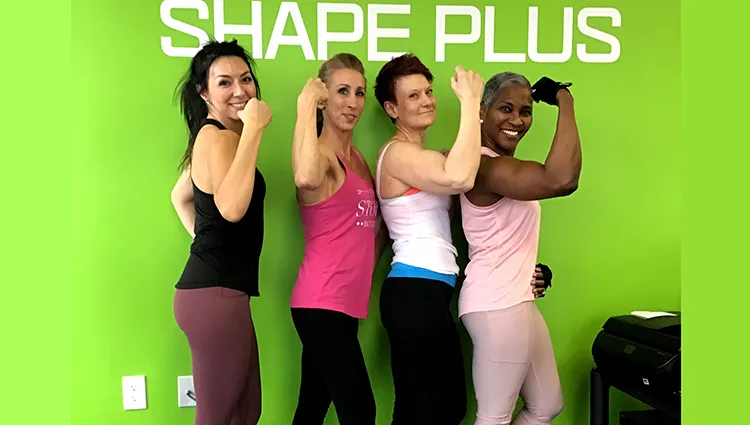
I see women encouraging one another to use a little more weight than last time. They celebrate each other’s new personal bests and challenge one another.
That mentality is not just something you see with the guys anymore.
As a woman becomes stronger, you can often see the moment when her entire view of training starts to change.
Instead of simply trying to get through the workout, she starts wondering:
“What can I do next?”
She challenges herself. She trusts her body more. She starts believing that she really can continue improving.
It is almost like you can see the realization happen:
“Oh. Now I get it. I really get it.”
That is one of the most rewarding things about strength training—and one of the reasons I believe women should continue challenging themselves as they get older rather than automatically backing off.
Protein, Nutrition and Recovery Matter Too
Training creates the stimulus.
Recovery gives your body the opportunity to adapt to it.
That makes nutrition, sleep and recovery important parts of a successful strength-training program, especially when the goal is to preserve or build lean muscle.
Protein supplies amino acids used during muscle repair and remodeling. Overall food intake matters too.
Constantly under-eating while asking your body to train harder is not necessarily a good recipe for progress.
That does not mean every woman over 40 needs the same diet, protein target or number of calories.
Nutrition should match the individual.
Recovery matters too. Hard training every single day is not automatically more effective than training intelligently and allowing the muscles you trained enough time to recover.
Sleep deserves attention as well. If sleep becomes more difficult during perimenopause, it becomes even more important to look at the entire training picture instead of judging success only by what happens during the hour you are in the gym.
Common Strength-Training Mistakes Women Make After 40
One of the biggest mistakes is never allowing the weights to become more challenging.
You do not need to chase numbers recklessly, but your program should create progression.
Another mistake is changing workouts constantly. Variety can be useful, but if every workout is completely different, it becomes difficult to measure whether you are actually getting stronger.
Doing only cardio is another common problem.
Training hard every day without paying attention to recovery can also work against you. More exercise is not automatically better exercise.
And perhaps one of the biggest mistakes is assuming certain exercises are automatically off-limits simply because you are over 40.
Age alone does not determine what you can or cannot do.
Your training history, mobility, health, injuries, strength and technique matter much more.
The goal is not to train exactly as you did at 25.
The goal is to train appropriately for the person you are today and continue improving from there.
Will Lifting Weights Make Women Bulky?
This fear has kept women away from strength training for decades.
Building a large amount of muscle does not happen accidentally.
Significant muscular development requires progressive training, adequate nutrition, genetics, consistency and time.
Strength training can be adjusted to match the amount of muscle, definition and strength you want.
For most women over 40, the bigger concern should not be accidentally building too much muscle.
It should be losing muscle and strength unnecessarily as the years go by.
You Are Not Starting Too Late
Maybe you have never lifted weights before.
Maybe you were strong years ago and life got in the way.
Maybe you spent the last decade doing cardio and are only now realizing how important muscle is.
It does not matter where you are starting.
Whether you are 41, 48, 55, 65 or beyond, getting stronger still matters.
You do not need to train like you are 22.
You need to become stronger than you are today.
Strength Training for Women Over 40 at Shape Plus
At Shape Plus, we do not believe women over 40 need a generic “menopause workout.”
They need intelligent, individualized training.
That means a program built around your current fitness level, goals, experience, injuries, lifestyle and schedule.
Your training should progress as you progress.
For some women, that means learning basic strength exercises for the first time.
For others, it means lifting heavier, improving technique, adjusting training volume or finally following a structured program instead of guessing every time they walk into the gym.
We combine personalized strength training with nutrition guidance, accountability and ongoing adjustments so you have a plan—and someone making sure that plan continues moving forward.
You can train with Shape Plus through Denver personal training, DTC / Greenwood Village personal training or Online Personal Training.
The goal is the same:
Get stronger. Stay capable. Build a body that continues working for you for years to come.
Frequently Asked Questions
How often should a woman over 40 strength train?
For many women, two to three focused strength-training sessions per week is a practical starting point. The right frequency depends on your goals, experience, workout volume and ability to recover.
Can women build muscle after 40?
Absolutely. Women can continue improving strength and building muscle well after 40. Consistent training, progressive resistance, appropriate nutrition and adequate recovery all play a role.
Is strength training good during perimenopause?
Strength training can be especially valuable during perimenopause because it supports muscle and bone strength during a period when hormonal changes may affect both. Training should still be individualized to the woman.
Will lifting heavy weights make women bulky?
Not accidentally. Building substantial muscle takes progressive training, appropriate nutrition, genetics and time. A good strength program can be designed around the amount of muscle, definition and strength you want.
Ready to Get Stronger?
Being over 40 is not a reason to lower your expectations.
It is a reason to make your training count.
If you are ready to build strength, preserve muscle and follow a program designed around your body and goals, Shape Plus can help.
Book your free goal assessment and let’s build a stronger version of you.